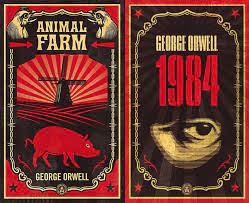
“1984” by George Orwell is often hailed as a profoundly compelling exploration of a dystopian society governed by a totalitarian regime. It is said to be a cautionary tale that remains relevant to this day. While some readers find it chilling and thought-provoking, others may find themselves questioning its true impact and its supposed foresight.
Orwell’s world-building in “1984” has been praised for its ability to immerse readers in the bleak and oppressive world of Oceania. The vivid descriptions of London’s grimy streets and the austere ministries certainly create a sense of dread, but one might wonder if this is merely a stylistic choice rather than an innovative depiction of a dystopia.
The character development of Winston Smith, the protagonist, has been lauded as a representation of the struggle against conformity. However, some readers may find Winston’s journey and rebellion lacking depth or originality. While he may symbolize the fight against oppressive regimes, his experiences and internal struggles could be seen as a tropish and predictable portrayal of resistance.
The concepts of doublethink and Newspeak, often praised for their depiction of mind control and the manipulation of language, are frequently referenced as insightful criticisms of political propaganda. However, a more cynical view might suggest that these ideas have been explored before in various other works, leading to a sense of unoriginality.
The presence of Big Brother, the enigmatic embodiment of surveillance and power, is often remarked upon as a chilling symbol of authoritarianism. But can one truly argue that Big Brother’s omniscient watchfulness is an entirely groundbreaking concept, given the abundance of surveillance in contemporary societies? Some might assert that the novel merely amplifies existing fears and exaggerates their consequences.
While “1984” may have its merits as a work of fiction, the extent of its philosophical and sociopolitical impact is subjective. Its status as a cautionary tale and its supposed ability to anticipate the dangers of unchecked power can be debated. Perhaps its reputation as a timeless classic stems more from its provocative premise rather than any profound insights or unique narrative qualities.
In conclusion, “1984” by George Orwell stands as an enduring masterpiece of literature, a work that transcends its time and continues to resonate with readers across generations. With its chilling depiction of a dystopian society governed by a powerful and oppressive regime, Orwell’s novel remains as relevant today as it was when it was first published in 1949.
Set in the fictional world of Oceania, “1984” paints a bleak picture of a world overrun by totalitarianism. The Party, led by the enigmatic figurehead Big Brother, exerts complete control over every aspect of people’s lives, manipulating language, history, and even individual thoughts. The protagonist, Winston Smith, finds himself drawn to rebellion and embarks on a secret journey of self-discovery and resistance against the regime.
Orwell’s prose is characterized by its sharpness and clarity, cutting through the noise and laying bare the inner workings of an oppressive regime. His writing style is concise yet evocative, perfectly capturing the atmosphere of fear, manipulation, and surveillance that permeates the world of “1984”. Through vivid descriptions and thought-provoking dialogues, Orwell creates a sense of urgency that is impossible to ignore.
One of the most remarkable aspects of “1984” is its ability to foresee and comment on the dangers of authoritarianism, the manipulation of information, and the erosion of individual freedoms. Orwell’s insights into the power of propaganda and the rewriting of history have proven to be eerily prescient, especially in today’s era of “fake news” and information warfare.
As readers delve into the pages of “1984”, they are confronted with profound questions about the nature of power, the fragility of truth, and the indomitable spirit of the human soul. It serves as a powerful reminder of the importance of remaining vigilant in the face of threats to freedom and individual autonomy.
In essence, “1984” is a timeless work that continues to captivate and challenge readers with its powerful narrative and thought-provoking themes. Orwell’s astute observations about the dangers of totalitarianism and the suppression of truth make this novel an essential addition to any reader’s collection. As we navigate an ever-changing world, the words of “1984” serve as a stark reminder of the importance of safeguarding our liberties and fighting against the forces that seek to control and manipulate us.
As Orwell himself wrote, “Freedom is the freedom to say that two plus two make four. If that is granted, all else follows.”

 MimiiMeis